Premise Works · Product launch
Compile the range.
Introducing redStackPro v1.0—a local-first visual compiler for authorized cyber ranges and purple-team architecture.
Explore redStackPro on GitHub ↗The premise
A cyber range should be compiled.
Cyber-range design usually begins in one tool and fragments across five more. The network lives in a diagram. Terraform lives in a repository. Ansible lives somewhere else. Detection logic arrives later—if it arrives at all.
I built redStackPro around a different idea. The visual canvas captures a provider-neutral topology. A Rust compiler normalizes it into a typed intermediate representation, validates relationships across the graph, binds supported targets, and emits reviewable infrastructure and detection artifacts.
Those artifacts can include Terraform, Ansible, Salt/Jinja, Sigma detection contracts, an ATT&CK Navigator layer, a Cyber Kill Chain walkthrough, and human-readable briefings. The boundary is intentional: redStackPro compiles; it does not deploy.
Compiler architecture
One graph. Two IR layers. A reviewable result.
The same compiler serves the GUI and the headless CLI. Topology and scenarios remain separate: the first describes what exists; the second describes what is being examined.
Capture
Nodes, edges, properties, and positions become provider-neutral JSON.
Normalize
Stable identifiers and explicit types turn the drawing into a contract.
Validate
Structural, semantic, recovery, authority, and cross-layer checks fail early.
Bind
Provider and capability adapters translate supported portions of the graph.
Emit
Sorted resources produce deterministic infrastructure and detection files.
Review
The export is a handoff. Nothing is executed from the canvas.
Enterprise modeling
More than boxes and arrows.
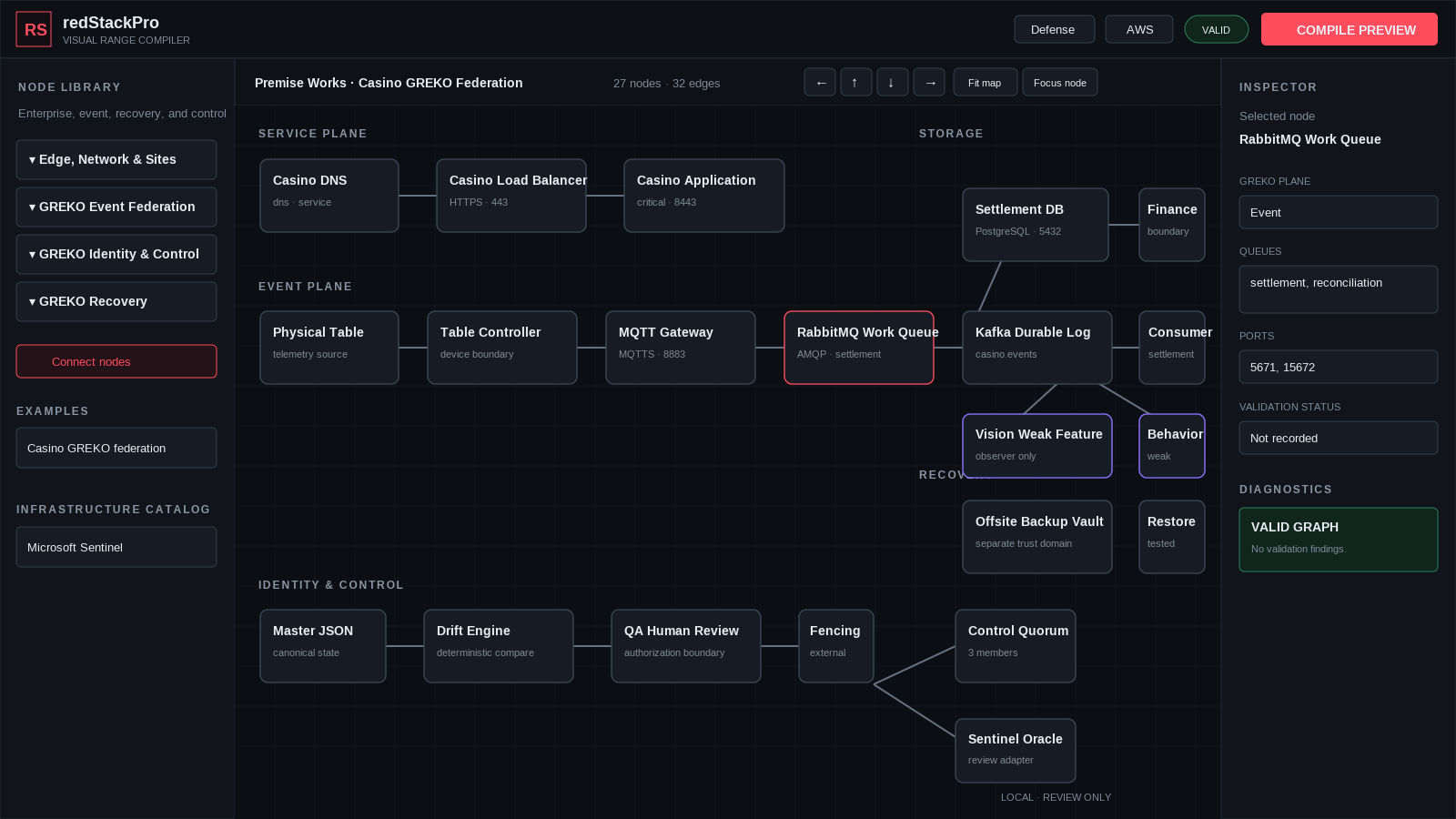
redStackPro carries meaning through typed nodes and edges. It can model enterprise identity, Kubernetes, NAT and DMZ paths, message brokers, databases, SOC components, current firewall families, HA patterns, storage, and disaster recovery.
- Active Directory forests, domain controllers, trusts, and endpoints
- Kubernetes clusters, workloads, registries, ingress, and observability
- WAF, load balancer, Tomcat, RabbitMQ, Kafka, DB2, MongoDB, and CouchDB tiers
- Firewalls, fabrics, EDR/SOC capabilities, HA pairs, and DR replicas
- Model-only exposure analysis and probable-path visualization
Purple-team planning
Map the scenario without running it.
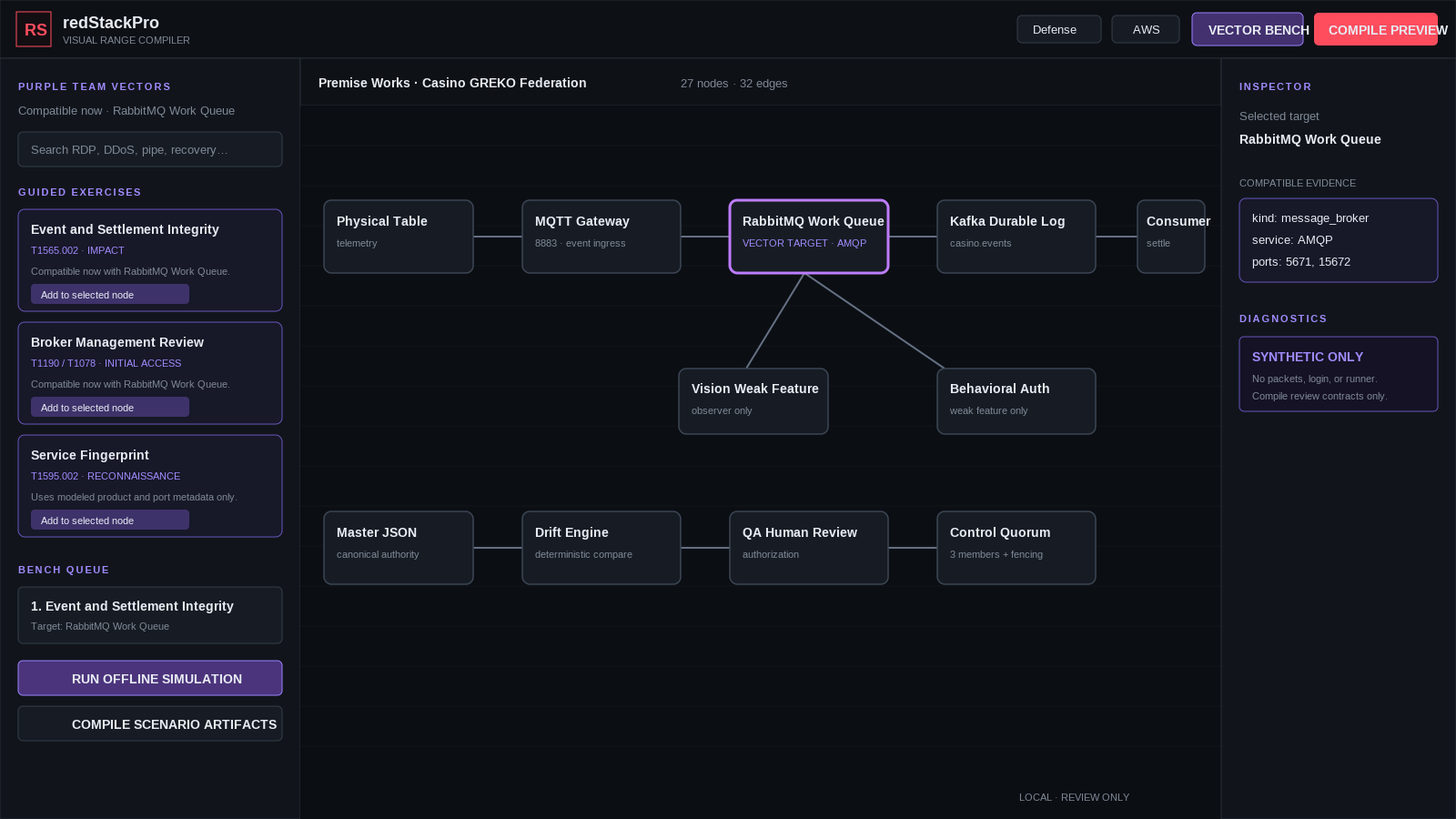
The Vector Bench is a second palette for synthetic tabletop scenarios. Select a modeled node, search MITRE Enterprise, Mobile, or ICS techniques with technical IDs or familiar language, and see what is compatible with the target.
Cards become an ordered scenario with prerequisites, targets, telemetry, and detection contracts. Incompatible choices are greyed out. Nothing sends traffic or executes a test.
- Friendly search aliases including RDP, SSH, pipe, DDoS, and CryptoLocker
- Five deliberately weak Vector Labs for visible review paths
- Cyber Kill Chain Markdown, Sigma contracts, Navigator JSON, and briefings
Case study
The Casino GREKO federation.
The most complete v1.0 example models a defensive federation as five cooperating planes—and compiles the rules between them.
Vision and behavioral observers are weak-feature producers, not unquestionable authorities. The compiler rejects designs where weak evidence directly authorizes irreversible action. Quorum membership, external fencing, control-plane separation, and recovery proof become validation concerns rather than footnotes.
That is the difference between drawing a system and compiling one: the architecture begins to defend its own intent.
Review artifacts
Infrastructure and detection, together.
A combined export organizes provider scaffolds, configuration placeholders, scenario metadata, detection contracts, and explanation in one deterministic directory.
AWS has minimal scaffold binding. GCP and Azure emit explicit TODO blocks where coverage is incomplete. Sentinel, PAN-OS, and Falcon have review adapters; other capabilities remain honest stubs. An adapter should fail clearly or degrade with a notice—never pretend to be complete.
The safety model
What it deliberately does not do.
Security tooling is often defined as much by its exclusions as its features. The design application has no need to hold deployment authority.
The modeled “scan” is graph traversal over in-memory JSON edges. Generated files still require engineering review, provider testing, secret management, approval, and a deployment workflow outside redStackPro.
Built in Rust
A local compiler with visible boundaries.
Rust gives the compiler explicit types, exhaustive enums, predictable ownership, and a workspace that separates topology, validation, binding, emission, CLI, and GUI concerns. The local GUI listens on loopback and calls the same compiler as the command line.
Choose a blueprint, inspect the graph, add compatible tabletop vectors, and open Compile preview. Nothing is deployed from the browser.
